Home » Blood Pressure Guide » Home Blood Pressure Monitoring » How to Choose the Right Blood Pressure Monitor
How to Choose the Right Monitor
Author: Dr. Vrolijk | Updated: August 23, 2025 | Disclaimer | Review Process | References
Not sure which blood pressure monitor to buy? Confused about cuff sizes and why they matter? Wondering if cheaper monitors work just as well as expensive ones?
This page explains the pros and cons of upper arm vs wrist monitors, how to get the best one for you, and how to read your monitor.
On This Page:

Choosing the Right Monitor Type
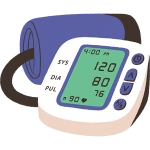
Upper Arm Monitors
Upper arm monitors are more accurate for most people. They are easier to use and get the right reading.

Wrist Monitors
Wrist monitors can work if you can’t use an upper arm cuff. For example, if your arm doesn’t fit in an upper arm cuff or you’ve had surgery to remove underarm lymph nodes. But they’re harder to use correctly. The sensor must be exactly at heart level. They don’t work as well if you have artery problems.
What about Smart Watches?
Some newer devices measure blood pressure. Scientists are still testing how well they work. For now, an upper arm cuff is the most reliable option.
If you want to use a watch, keep taking your blood pressure with a home monitor. You can compare your readings to see how well the watch is working. Even if it’s working at first, keep checking sometimes in case the watch stops working as well.
Are Cheaper Monitors Accurate?
Price doesn’t mean a monitor is better. A $35 validated monitor can be just as accurate as a $100 one. The most important thing is to get the right cuff size and one that has been tested.
Where to Find Accurate Blood Pressure Cuffs
ValidateBP.org is a nonprofit resource run by the American Medical Association. Their only job is testing blood pressure monitors. They do not get any money from companies, so they aren’t trying to sell you anything.
Getting the Right Cuff Size
Why Size Matters
Too Small
Can measure too high
Example:
Your blood pressure = 120/75
Too small cuff reading = 125/77
Too Large
Can measure too low
Example:
Your blood pressure = 120/75
Too large cuff reading = 117/74
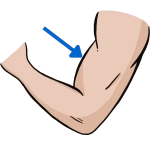
How to Measure Your Arm
Measure the middle of your upper arm. This is halfway from your shoulder to your elbow. You can use a flexible measuring tape or even your phone charging cord.
If you use a cord or string: Mark where the ends met. Measure it with a ruler or measuring tape.
Finding the Right Cuff
Check the cuff size range before you buy. Different brands have different size ranges. Unfortunately, there’s no standard “small,” “medium,” or “large.”
Look at the box or product description – it should say something like “fits arms 10-16 inches” or “22-32 cm.”
Can't Find the Right Size?
Ask at your pharmacy about different cuff options, or look for brands that make cuffs in your size range. Some companies sell separate cuffs that work with their monitors.
Reading Your Monitor
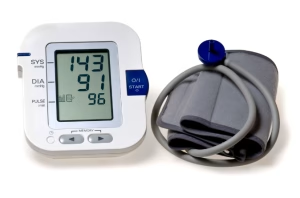
The blood pressure machine will usually show three numbers:
Top Systolic (SYS)
Middle Diastolic (DIA)
Bottom Pulse (Pul)
What Each Number Means
Systolic or SYS (Top)
Measures your blood pressure when your heart beats
This is when your heart pushes blood into your body
Diastolic or DIA (Middle or Bottom)
- Measures your blood pressure when your heart rests
- This is when your heart is filling with blood
Pulse or Pul (Bottom)
Measures how fast your heart is beating
Your heart is sometimes slower or faster
Some machines will show the fastest (max or maximum)
Quick Answers
Price doesn’t mean a monitor is better. A $35 validated monitor can be just as accurate as a $100 one. The most important thing is to get the right cuff size and one that has been tested.
You can see which monitors have been tested on ValidateBP.org. ValidateBP is a nonprofit and does not get money from companies for it’s reviews.
No. You can buy blood pressure monitors at pharmacies, online, or a medical supply store.
Doctors recommend upper arm monitors that have been checked for accuracy. Check ValidateBP.org for a list of tested monitors. Or ask your doctor’s office what brands they suggest.
Yes, as long as the cuff fits your arm.
What to Read Next
All of Our Pages on Blood Pressure

Resources We Used
Basile, Jan, and Michael J Bloch. “Overview of Hypertension in Adults.” UpToDate, Waltham, MA, 2015.
Coles, Sarah, Lynn Fisher, Kenneth W Lin, Corey Lyon, Alexis A Vosooney, and Melanie D Bird. “Blood Pressure Targets in Adults with Hypertension: A Clinical Practice Guideline from the AAFP.” American Family Physician 106, no. 6 (2022): 722A-722K.
Han M, Lee YR, Park T, et al. Feasibility and measurement stability of smartwatch-based cuffless blood pressure monitoring: A real-world prospective observational study. Hypertens Res. 2023;46(4):922-931. doi:10.1038/s41440-023-01215-z
US Preventive Services Task Force. Screening for Hypertension in Adults: US Preventive Services Task Force Reaffirmation Recommendation Statement. JAMA. 2021;325(16):1650-1656. doi:10.1001/jama.2021.4987
Weinfeld, Jeffrey M., Kathryn M. Hart, and Jose D. Vargas. “Home Blood Pressure Monitoring.” American Family Physician 104, no. 2 (September 2021): 237–43.
Review Process
We take quality seriously. Every health guide goes through this review process:
Medical Review
At least one doctor in the content field reviews all health information
MD, DO, PhD/PsyD, OD, DMD, DDS depending on the content
Doctors check that all medical facts are correct
We update our content when new medical evidence comes out
Sources & Evidence
- All content is based on current medical guidelines and research
- We cite our sources so you can learn more
Reading Level Check
- We test all content to make sure it’s easy to read
- We avoid medical jargon or explain it clearly when needed
- We break down complex topics into simple steps
Accessible Design
- We design materials to work for people with different needs
- We use clear fonts and good color contrast
- We organize content with clear headings and simple layouts
- We follow web accessibility guidelines
We regularly review and update our materials based on:
- New medical research
- User feedback
- Changes in medical guidelines
You can find the last update date at the top of each page.
Found an error or have a suggestion?
Contact Us – We want to fix it as soon as possible!
Disclaimer
The information provided by HealthEd for Everyone is for educational and informational purposes only and is not intended as medical advice. While we strive to ensure the accuracy and timeliness of this information, it should not be used as a substitute for professional medical consultation, diagnosis, or treatment. Always seek the advice of your physician or other qualified health provider with any questions you may have regarding a medical condition.
HealthEd for Everyone does not endorse or recommend any specific tests, physicians, products, procedures, opinions, or other information that may be mentioned within this material. Reliance on any information provided by HealthEd for Everyone is solely at your own risk.
In no event shall HealthEd for Everyone be liable for any direct, indirect, consequential, special, exemplary, or other damages arising therefrom.
By accessing this information, you acknowledge and agree to these terms and conditions. If you think you may have a medical emergency, call your doctor, go to the nearest hospital, or call emergency services immediately.
Don't see what you need?
Tell us what health topics confuse you. Your suggestions help us decide what to create next.