On this page
Home » Blood Pressure Guide » Low Blood Pressure
Low Blood Pressure
Author: Dr. Vrolijk | Updated: August 23, 2025 | Disclaimer | Review Process | References
Low blood pressure can make you feel lightheaded, especially when you stand up. If you pass out, feel like you might pass out, or have any other concerning symptoms, get emergency help right away. If you’re feeling lightheaded but okay, there are things you can do right away that can help.
There isn’t one number for low blood pressure. That’s because what counts as low depends on what’s normal for your body. If your normal blood pressure is 150/86, then a drop to 109/70 would be low blood pressure for you. But someone else’s blood pressure might be 92/68 every day and they feel fine.
This page walks you through when low blood pressure is a problem, what it can feel like, and when to get help.
When to Get Help
Call for Emergency Help if You Have Symptoms Like
- Chest pain, pressure, or discomfort
- Trouble breathing, sweating, upset stomach, or cold and clammy skin
- Pain in your arms, back, or jaw
- Faint or pass out
- Fall for no clear reason
- Throwing up or diarrhea and you can’t drink water
- Any other concerning symptoms
Call Your Doctor If You Have
- Dizziness or lightheadedness when you stand up
- Feeling tired or weak when you didn’t before
- Headache in the back of your neck and shoulders
- This can be a symptom low blood pressure when you stand up (called orthostatic hypotension)
- Any other new symptom that you’re worried about
Why Numbers Alone Don't Tell the Whole Story
You might hear that 90/60 is too low. But what matters most is how you feel and what’s normal for your body.
Someone used to higher blood pressure might feel awful when it drops, even if the numbers look “normal.” But someone who always runs low might feel fine with the same numbers.
Tricks for Dealing with Low Blood Pressure
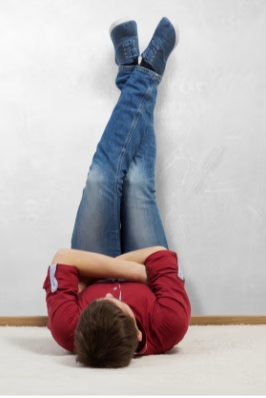
First, Stay Safe
- Sit or lie down
- Tell someone nearby how you’re feeling
Tricks That Can Help
- Elevate your legs – helps blood flow to your brain
- Cross your legs – helps raise your blood pressure
- Don’t get up quickly – slowly stand up and wait until you feel normal before walking
What Low Blood Pressure Can Feel Like
Most Common Symptoms
- Lightheaded or dizzy: Feeling like you might faint or pass out
- Your vision gets dark or blurry: Especially around the edges
You Might Also Feel
- Unsteady on your feet
- Like you need to sit back down
- Your legs feel weak or “buckle”
- More Tired or fatigued
- Headache in the back of your head, neck, or shoulders
These Symptoms Can Happen
- When you stand up (called orthostatic hypotension)
- After eating a large meal
- In hot weather
- When you’re dehydrated
Quick Answers
There isn’t one specific “danger zone” number. What matters is how you feel and what’s normal for your body. For example, someone might feel fine with blood pressure around 100/65. Another person might feel awful if their pressure drops from 160/80 to 110/68.
Usually low blood pressure on its own won’t cause a stroke.
Your body works to keep blood flowing to your brain. When blood pressure drops, you feel dizzy so you’ll sit or lie down. This helps blood reach your brain.
Low blood pressure can be dangerous when you’re very sick (like from bleeding or infection). But then it’s the serious illness causing the problem – not just the low blood pressure.
Low blood pressure can make you feel tired and weak. When your blood pressure is low, your muscles and organs may get less oxygen and nutrients. This can make you feel tired and weak.
Anxiety usually raises blood pressure, because it triggers your body’s “fight or flight” response. If you’re feeling anxious and have low blood pressure, there’s probably another cause. Some health conditions can make you feel anxious and lower blood pressure. So, it’s a good idea to see a doctor to see if there is an underlying cause.
Drinking a moderate amount of coffee every day doesn’t appear to change blood pressure much. But if you don’t usually drink coffee, the caffeine might briefly raise your blood pressure.
Some studies show that drinking sugary beverages are associated with higher blood pressure.
Related Articles
Home Blood Pressure Monitoring
Learn when home monitoring helps, how to choose the right monitor, and how to make sure your readings are accurate.
Emergency Room Guide
Learn what to expect, ways to speak up for yourself, and how to leave the ER with the information you need.
Blood Pressure Medicine Types
Learn about the different types of blood pressure medicines, how they work, and what you can do for common side effects.
Don't see what you need?
Tell us what health topics confuse you. Your suggestions help us decide what to create next.
Resources We Used
Baggish AL, Wood MJ. Athlete’s Heart and Cardiovascular Care of the Athlete. Circulation. 2011;123(23):2723-2735. doi:10.1161/CIRCULATIONAHA.110.981571
Benditt D. Syncope in adults: Management and prognosis. UpToDate [Internet] Waltham, MA: UpToDate. Published online 2022. Accessed July 21, 2025. https://www.uptodate.com/contents/syncope-in-adults-management-and-prognosis
Benditt D, Kowey P, Yeon SB. Reflex syncope in adults and adolescents: Clinical presentation and diagnostic evaluation. Published online 2019. Accessed July 21, 2025. https://www.uptodate.com/contents/reflex-syncope-in-adults-and-adolescents-clinical-presentation-and-diagnostic-evaluation
Bordeaux B, Lieberman HR. Benefits and risks of caffeine and caffeinated beverages. UpToDate Published. Published online 2022.
Brown IJ, Stamler J, Van Horn L, et al. Sugar-Sweetened Beverage, Sugar Intake of Individuals, and Their Blood Pressure. Hypertension. 2011;57(4):695-701. doi:10.1161/HYPERTENSIONAHA.110.165456
Chen RJ, Sharma S, Bhattacharya PT. Hypotension. In: StatPearls. StatPearls Publishing; 2025. Accessed July 21, 2025. http://www.ncbi.nlm.nih.gov/books/NBK499961/
Homoud MK. Sinus bradycardia. UpToDate Post TW, Waltham, MA. Published online 2024. Accessed July 21, 2025. https://www.uptodate.com/contents/sinus-bradycardia
Palma JA, Kaufmann H, Kowey P. Treatment of orthostatic and postprandial hypotension. UpToDate, Waltham. Published online 2022. Accessed July 21, 2025. https://www.uptodate.com/contents/5105
Ricci F, De Caterina R, Fedorowski A. Orthostatic Hypotension. JACC. 2015;66(7):848-860. doi:10.1016/j.jacc.2015.06.1084
Surma S, Oparil S. Coffee and Arterial Hypertension. Curr Hypertens Rep. 2021;23(7):38. doi:10.1007/s11906-021-01156-3
Wieling W, Kaufmann H, Claydon VE, et al. Diagnosis and treatment of orthostatic hypotension. The Lancet Neurology. 2022;21(8):735-746. doi:10.1016/S1474-4422(22)00169-7
Review Process
We take quality seriously. Every health guide goes through this review process:
Medical Review
At least one doctor in the content field reviews all health information
MD, DO, PhD/PsyD, OD, DMD, DDS depending on the content
Doctors check that all medical facts are correct
We update our content when new medical evidence comes out
Sources & Evidence
- All content is based on current medical guidelines and research
- We cite our sources so you can learn more
Reading Level Check
- We test all content to make sure it’s easy to read
- We avoid medical jargon or explain it clearly when needed
- We break down complex topics into simple steps
Accessible Design
- We design materials to work for people with different needs
- We use clear fonts and good color contrast
- We organize content with clear headings and simple layouts
- We follow web accessibility guidelines
We regularly review and update our materials based on:
- New medical research
- User feedback
- Changes in medical guidelines
You can find the last update date at the top of each page.
Found an error or have a suggestion?
Contact Us – We want to fix it as soon as possible!
Disclaimer
The information provided by HealthEd for Everyone is for educational and informational purposes only and is not intended as medical advice. While we strive to ensure the accuracy and timeliness of this information, it should not be used as a substitute for professional medical consultation, diagnosis, or treatment. Always seek the advice of your physician or other qualified health provider with any questions you may have regarding a medical condition.
HealthEd for Everyone does not endorse or recommend any specific tests, physicians, products, procedures, opinions, or other information that may be mentioned within this material. Reliance on any information provided by HealthEd for Everyone is solely at your own risk.
In no event shall HealthEd for Everyone be liable for any direct, indirect, consequential, special, exemplary, or other damages arising therefrom.
By accessing this information, you acknowledge and agree to these terms and conditions. If you think you may have a medical emergency, call your doctor, go to the nearest hospital, or call emergency services immediately.