
Home » Blood Pressure Guide » Home Blood Pressure Monitoring
Home Blood Pressure Monitoring
Author: Dr. Vrolijk | Updated: August 23, 2025 | Disclaimer | Review Process | References
Not sure if you need to check your blood pressure at home? Confused about which monitor to buy? Worried you’re not doing it correctly?
This page explains when home monitoring helps, how to choose the right monitor for you, and how to make sure you’re getting accurate readings.
On This Page:

Is Home Monitoring Right for Me?
When Home Monitoring Is Usually Recommended
- Have high blood pressure or take blood pressure medicine
- Aren’t able to go to the doctor for a yearly check up
- Need to check if your medicine is working
- Have blood pressure that’s different at home than the doctor’s office
- Started a medication that might make your blood pressure higher
Who Should Check at Home
Adults 40 and older: Should check once a year, even with normal blood pressure
Adults 18-39: Every 3-5 years if you have normal blood pressure and are at low risk for heart or vascular disease
Anyone taking blood pressure medicine: Checking every day or week helps you and your doctor make treatment decisions
During pregnancy: Home monitoring complements your prenatal care
Is It Accurate?
Yes. Studies even show home monitoring can be better than office measurements. But your monitor needs to work well, and you have to take your blood pressure correctly.
What Equipment Do I Need?
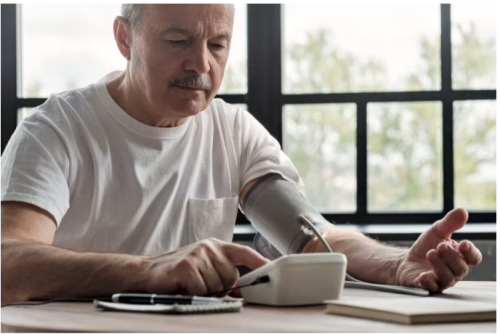
A Monitor
- Upper arm monitors are most accurate for most people
- Wrist monitors can work when upper arm ones don’t
Set Up
- Chair with back support – so you can sit upright
- Table or pillows – to rest your arm at heart level
- Quiet space – where you won’t be interrupted for a few minutes
What to Look for in a Monitor
- Right cuff size – measure your arm first
- Validated for accuracy – look for models doctors recommend
- Easy-to-read display – large numbers you can see clearly
How Do I Get Started?

Your First Readings
Take your blood pressure 1-2 times a day, or follow the schedule you and your doctor decided on. Morning and evening work best because this gives you time to rest before each measurement.
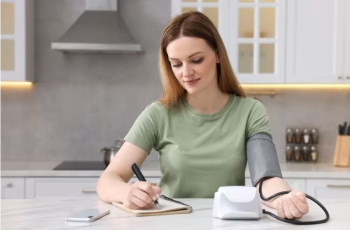
What to Expect
- Your first few readings might be higher than normal as you get the technique down
- The first reading might be higher than the second if you don’t rest first
- You won’t have the same readings each time, since blood pressure changes during the day
Making It a Habit
Pick regular times that fit your routine, like after brushing your teeth. Allow about 10 minutes total each time.
Write down your measurements so you can track patterns and catch problems early. Since you can’t feel blood pressure changes, tracking is the only way to know how you’re doing.
How Do I Know if I'm Doing It Right?
Ways to Make Sure You're Getting the Right Readings
- Bring your monitor to your doctor’s office – Ask them to check if it’s working well
- Ask your doctor’s office if you’re doing it right – Show them how you take your blood pressure
- Compare with a friend’s monitor – Take your blood pressure with both at the same time
Don't Worry about Small Differences
Blood pressure naturally changes throughout the day. Your second reading is often lower than the first. This is normal, because you rest more before the second one.
When to Get Help
If your readings are much higher or lower than usual, contact your doctor’s office.
What to Read Next
All of Our Pages on Blood Pressure

Resources We Used
Basile, Jan, and Michael J Bloch. “Overview of Hypertension in Adults.” UpToDate, Waltham, MA, 2015.
Coles, Sarah, Lynn Fisher, Kenneth W Lin, Corey Lyon, Alexis A Vosooney, and Melanie D Bird. “Blood Pressure Targets in Adults with Hypertension: A Clinical Practice Guideline from the AAFP.” American Family Physician 106, no. 6 (2022): 722A-722K.
US Preventive Services Task Force. Screening for Hypertension in Adults: US Preventive Services Task Force Reaffirmation Recommendation Statement. JAMA. 2021;325(16):1650-1656. doi:10.1001/jama.2021.4987
Weinfeld, Jeffrey M., Kathryn M. Hart, and Jose D. Vargas. “Home Blood Pressure Monitoring.” American Family Physician 104, no. 2 (September 2021): 237–43.
Review Process
We take quality seriously. Every health guide goes through this review process:
Medical Review
At least one doctor in the content field reviews all health information
MD, DO, PhD/PsyD, OD, DMD, DDS depending on the content
Doctors check that all medical facts are correct
We update our content when new medical evidence comes out
Sources & Evidence
- All content is based on current medical guidelines and research
- We cite our sources so you can learn more
Reading Level Check
- We test all content to make sure it’s easy to read
- We avoid medical jargon or explain it clearly when needed
- We break down complex topics into simple steps
Accessible Design
- We design materials to work for people with different needs
- We use clear fonts and good color contrast
- We organize content with clear headings and simple layouts
- We follow web accessibility guidelines
We regularly review and update our materials based on:
- New medical research
- User feedback
- Changes in medical guidelines
You can find the last update date at the top of each page.
Found an error or have a suggestion?
Contact Us – We want to fix it as soon as possible!
Disclaimer
The information provided by HealthEd for Everyone is for educational and informational purposes only and is not intended as medical advice. While we strive to ensure the accuracy and timeliness of this information, it should not be used as a substitute for professional medical consultation, diagnosis, or treatment. Always seek the advice of your physician or other qualified health provider with any questions you may have regarding a medical condition.
HealthEd for Everyone does not endorse or recommend any specific tests, physicians, products, procedures, opinions, or other information that may be mentioned within this material. Reliance on any information provided by HealthEd for Everyone is solely at your own risk.
In no event shall HealthEd for Everyone be liable for any direct, indirect, consequential, special, exemplary, or other damages arising therefrom.
By accessing this information, you acknowledge and agree to these terms and conditions. If you think you may have a medical emergency, call your doctor, go to the nearest hospital, or call emergency services immediately.
Don't see what you need?
Tell us what health topics confuse you. Your suggestions help us decide what to create next.