Home » Managing Healthcare Anxiety » Quick Tools to Manage Healthcare Anxiety
Quick Tools to Manage Healthcare Anxiety
Author: Dr. Vrolijk | Updated: August 23, 2025 | Disclaimer | Review Process | References
Need tools you can use anywhere? Want techniques that actually work when you’re nervous?
Medical anxiety is real and common. You’re not alone if your mind races before appointments or your body tenses up in medical settings.
This page has simple strategies to reduce anxiety. You can use them before or during an appointment, procedure, or anytime you feel worried.
On This Page:

Simple Tools to Feel Calmer
These tools help you manage worry and feel more in control during healthcare appointments.
Practice when you’re calm first. This makes the techniques easier to use when you actually need them. You can use these anywhere – in waiting rooms, during procedures, or even while getting blood drawn.
Try different tools to see what works best for you. Everyone responds differently to different techniques.
Have a strategy that works well for you? Let us know – it might help someone else too.
Fidget Toys
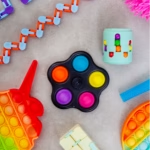
Fidget toys can help you be more in your body. They focus some of your energy and attention but don’t take much mental effort. They can be more helpful than playing a game on your phone, because they use touch (also called tactile).
You can pick any fidget toy: a spinner, slider, etc. If you don’t have one, you can try spinning a pen between your fingers.

Temperature Change

Use something cold or hot to help bring your attention back to your body. If you’ve ever splashed water on your face, you’ve used this tool.
For something hot, you can use a heating pad or a hand warmer.

5-4-3-2-1 Grounding
Time Needed: 2 – 3 minutes | Difficulty: Easy

How to Do It
- Identify 5 things you can see
- Notice 4 things you can touch or feel
- Listen for 3 different sounds
- Find 2 things you can smell (or like to smell)
- Notice 1 thing you can taste (or like to taste)
Quick Version
- Find 3 things you can see
- Notice 2 things you can feel
- Listen for 1 sound
🎯 You're Doing This Right if
Your attention shifts to your surroundings and away from anxious thoughts.
Guided Imagery
Time Needed: 3 – 4 minutes | Difficulty: Medium

How to Do It
- Get comfortable and close your eyes if possible
- Take 3 slow, deep breaths
- Picture a peaceful place you love
- Notice what you see, hear, smell, and feel there
- Explore this place in your mind for a few minutes
- Take 3 deep breaths and slowly open your eyes
Quick Version
- Close your eyes and take 3 deep breaths
- Picture your favorite calm place for 30 seconds
- Focus on one thing you see, hear, or feel there
- Take one more deep breath before opening your eyes
✷ Many people find it helpful to listen to someone talking them through a guided imagery exercise. You can find ones online by searching “guided imagery” or “guided visualization.”
🎯 You're Doing This Right if
Your breathing slows and your muscles relax, even if it’s just a little.
Muscle Relaxation
Time Needed: 3 – 4 minutes | Difficulty: Easy

How to Do It
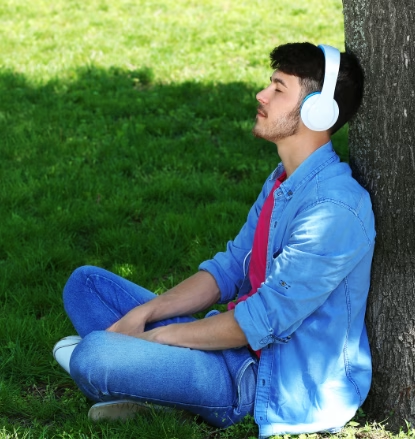
- Sit comfortably with feet on the ground
- Tense your toes for 5 seconds, then relax for 10 seconds
- Move up: feet → legs → stomach → hands → arms → shoulders → neck → face
- Take a deep breath between each muscle group
- Notice the difference between tense and relaxed
Quick Version
- Focus on shoulders, hands, and jaw
- Tense each area for 3 seconds, then release
- Take one deep breath between each area
🎯 You're Doing This Right if
You notice the difference between tense and relaxed muscles
🚨 If You Feel More Anxious
It’s not because you did it wrong. Some people can feel more anxious after doing muscle relaxation. If you notice this, try a fidget toy or the 5-4-3-2-1 grounding exercise.
Body Scan
Time Needed: 3 – 4 minutes | Difficulty: Medium

How to Do It
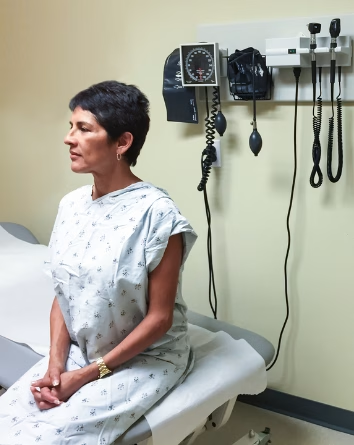
- Sit or lie down comfortably
- Close your eyes and take 3 deep breaths
- Start at your feet – notice how they feel
- Slowly move your attention up through your whole body
- Notice areas that feel tense, relaxed, or neutral
- End with a deep breath and open your eyes when ready
Quick Version
- Sit or lie comfortably and take 3 deep breaths
- Notice your feet, then slowly move attention up through your body
- Pay attention to areas that feel tense or comfortable
- End with a deep breath and open your eyes when ready
🎯 You're Doing This Right if
You notice how different parts of your body feel – tense, relaxed, etc.
🚨 If You Feel More Anxious
It’s not because you did it wrong. Some people can feel more anxious after doing a body scan exercise. If you notice this, try a fidget toy or the 5-4-3-2-1 grounding exercise.
What to Read Next

Resources We Used
Clinical experience from multiple clinicians
Bentley TGK, D’Andrea-Penna G, Rakic M, et al. Breathing Practices for Stress and Anxiety Reduction: Conceptual Framework of Implementation Guidelines Based on a Systematic Review of the Published Literature. Brain Sci. 2023;13(12):1612. doi:10.3390/brainsci13121612
Review Process
We take quality seriously. Every health guide goes through this review process:
Medical Review
At least one doctor in the content field reviews all health information
MD, DO, PhD/PsyD, OD, DMD, DDS depending on the content
Doctors check that all medical facts are correct
We update our content when new medical evidence comes out
Sources & Evidence
- All content is based on current medical guidelines and research
- We cite our sources so you can learn more
Reading Level Check
- We test all content to make sure it’s easy to read
- We avoid medical jargon or explain it clearly when needed
- We break down complex topics into simple steps
Accessible Design
- We design materials to work for people with different needs
- We use clear fonts and good color contrast
- We organize content with clear headings and simple layouts
- We follow web accessibility guidelines
We regularly review and update our materials based on:
- New medical research
- User feedback
- Changes in medical guidelines
You can find the last update date at the top of each page.
Found an error or have a suggestion?
Contact Us – We want to fix it as soon as possible!
Disclaimer
The information provided by HealthEd for Everyone is for educational and informational purposes only and is not intended as medical advice. While we strive to ensure the accuracy and timeliness of this information, it should not be used as a substitute for professional medical consultation, diagnosis, or treatment. Always seek the advice of your physician or other qualified health provider with any questions you may have regarding a medical condition.
HealthEd for Everyone does not endorse or recommend any specific tests, physicians, products, procedures, opinions, or other information that may be mentioned within this material. Reliance on any information provided by HealthEd for Everyone is solely at your own risk.
In no event shall HealthEd for Everyone be liable for any direct, indirect, consequential, special, exemplary, or other damages arising therefrom.
By accessing this information, you acknowledge and agree to these terms and conditions. If you think you may have a medical emergency, call your doctor, go to the nearest hospital, or call emergency services immediately.
Don't see what you need?
Tell us what health topics confuse you. Your suggestions help us decide what to create next.