Giving Tuesday: We Doubled Our Goal!
We set out to raise $250 during Giving Tuesday. You helped us raise $535.62. That’s more than double what we hoped for! Your donations keep our website running, help us print resources, and support new projects like our STI resources and children’s books. Thank you!
A Message from Aaron: Looking Back at 2025
2025 has been a rough year. And that might be the understatement of the year.
It was a hard year for nonprofits everywhere, especially those working on public health and patient education. Funding dried up. Programs shut down. Many organizations that had been around for years had to lay off staff or close entirely. And here we were, just getting started.
But we didn’t just survive this year. We actually grew. We got 501(c)(3) status. Launched a new website. Revamped all our materials. Started this newsletter and began sharing on social media. We showed up at community health fairs. Finished the illustrations for our first children’s book. Built partnerships and started sharing printed materials for clinical spaces.
I’ll be honest: there are days when I wonder if we’ll make it. Fundraising, building our operations, finding volunteers—all challenging. The learning curve as an executive director who also creates the bulk of our content has been steep.
But then people show up and support in ways that have been critical to keeping HealthEd 4 Everyone and me going. I’m grateful for everyone who donated this year. You kept the lights on (or, more accurately, the website running and resources being printed). And I’m grateful to everyone who has helped me figure out how to serve our mission. Because, at the end of the day, I’m here to ensure everyone understands their care, can get reliable answers to their questions, and have the information they need to make decisions.
I’ve learned so much this year. Perhaps most importantly: this work isn’t about me figuring everything out alone. It’s about the people who take time to review a draft, suggest a better way to explain something, point out what we’re missing, or just talk to me on a hard day. Those people are why I’m still here.
Looking ahead to 2026, I’m genuinely excited. The sexually transmitted infection (STI) resources are almost ready; resources built around the actual questions people have. “I Can Get an Ultrasound” will be available to help kids and their families understand the ultrasound process (including options for self care during the procedure). We’re collaborating with Chronically Informed to combine patient stories with clear health education. We’re reaching more people every month through our website, social media, and resource requests. We’ll continue expanding to clinics and community spaces.
Most of all, I’m excited to keep doing the work we set out to do: making sure everyone can understand their care, get reliable answers to their questions, and have the information they need to make decisions about their health.
And we need your help. We’re looking for board members who can help us build and grow (more on that below).
Thank you for being part of this. If you ever want to talk about our work or have suggestions for a young nonprofit, please reach out. I still have a lot to learn, and we love collaborating.
— Aaron
What We Published This Month
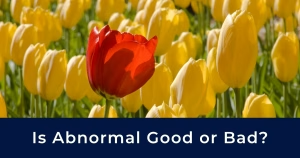
Why Abnormal Lab Results Don't Always Mean Something's Wrong
MCH
Normal range: 27.0 - 32.0 pg
The other day I logged into my medical chart and saw a bright yellow “abnormal” label next to one of my blood tests. I clicked on it. There was no explanation. Just another alert telling me my value was “High.”
If I weren’t a doctor, I would be worried. The yellow demands attention. The green zone looks safe. It feels like a check engine light: something is either wrong or it’s not.
But labs aren’t that simple. Thankfully, I am a doctor, so I know my result is okay. Most people wouldn’t have that context. And why would you?
What You'll Learn from This Post
- If you get enough lab tests, everyone will have some results flagged as “abnormal”
- Every body is different, so some “abnormal” results are actually your body’s normal
- Reference ranges are guidelines based on other people—not tailored to you
- Context usually matters more (your other labs, health history, how you’re feeling)
- If in doubt or worried, you can and should ask what your results mean for you
We also published: What Is Blood Pressure? – Ever wondered what those two numbers mean when you get your blood pressure checked? This post explains it using simple comparisons.
We Need Board Members
We’re looking for board members who can dedicate time to fundraising, making connections, and helping build our operations.
We especially need a Treasurer and Secretary, but we’re also looking for people who have availability to actively participate and work alongside us as we grow.
You don’t need experience. We’re committed to providing board training and support. What matters is that you’re aligned with our values, ready to learn, and have the time to help us build.
Want to learn more about what’s involved? Email: info@healthed4everyone.org
Illustrations Complete for "I Can Get an Ultrasound!"

All the illustrations are complete! We’re doing final edits now with our collaborators.
This children’s book helps prepare kids (especially those with autism) for getting an ultrasound. It shows what will happen step-by-step with clear pictures and includes options for self-care during the procedure—like asking for breaks, getting a blanket, or looking at the pictures.
What’s next: We need donations to print these books and distribute them for free to families and healthcare providers who work with autistic children.
We’re still looking for an illustrator for our second book, “I Can Go to the Doctor.”
Interested illustrators: Email info@healthed4everyone.org
Behind the Scenes: STI Resources
We’ve been saying “STI resources are coming soon” for a few months now. Here’s why and where we actually are.
We started by listening. Before writing anything, we researched what people actually search for when they have questions about STIs. What are they worried about? What words do they use? We looked at anonymous search data from Corner Health Center (a clinic serving young people in Washtenaw County) and broader search trends. This helps us answer the questions people are really asking and not just providing the information we as doctors think is most important.
Then we looked at what already exists. There’s a lot of STI information online, but much of it is clinical or hard to navigate. We wanted to understand what’s missing.
Next came the map. This part is called “information architecture,” basically organizing content so people can find what they need. If someone is anxious about symptoms, they need a different starting point than someone who just got test results. We mapped out how all the pages connect: symptom guides, testing information, treatment, telling partners, prevention, and individual pages for each STI.
Now we’re drafting. We’re writing the individual STI pages first (chlamydia, gonorrhea, herpes, and so on), because everything else links back to them. Each page follows the same structure so the information is predictable and easy to scan.
What’s next: Medical review, then building the pages on our website. We’ll share more as we go.
Have questions about STIs you’ve always wanted answered in plain language? Let us know—it helps us make sure we’re covering what matters most.
Email: info@healthed4everyone.org
Ways to Support Our Work
💙 Donate
Where your money goes: Your donation helps us print our children’s book series, create sexual health resources, and provide more free print materials to communities that need them.
We’re a small nonprofit making health information understandable for everyone. Every donation—whether $10 or $100—helps us reach more people.
🤝 Volunteer
Help us create better health education on your schedule. We need help with user testing, content feedback, website improvements, and more. No matter what your skills, you can help.
We’re also hiring an illustrator for our children’s book series “I Can Go to the Doctor.”
Get involved: info@healthed4everyone.org
💬 Share Your Ideas
What health topics confuse you? What do you wish your doctor had time to explain?
Email us: info@healthed4everyone.org
📣 Spread the Word
Know someone who might benefit from easy-to-understand health information? Forward this newsletter or share HealthEd4Everyone.org
Get Our Print Resources
We create resources meant to be shared—in waiting rooms, community centers, schools, churches, or your own home.
Email:info@healthed4everyone.org
Online form: Request Print Resources