On this page
Home » Blood Pressure Guide » Simple Lifestyle Changes to Lower Your Blood Pressure » 3 Most Important Changes for Better Blood Pressure
3 Most Important Changes for Blood Pressure
Author: Dr. Vrolijk | Updated: August 23, 2025 | Disclaimer | Review Process | References
You’ve probably heard that eating better and exercising more helps blood pressure. It sounds simple but is hard to do. Most people can’t change everything at once.
That’s why this page focuses on the three changes that help blood pressure the most. Instead of big goals like “exercise more,” you’ll find small, concrete steps you can start with today.
The Big 3 that Matter Most
With so much advice about blood pressure, it’s hard to know where to start. Research shows these three changes help most people the most:

1. Cut Back on Salt
Salt is the number one food culprit for raising blood pressure. Most Americans eat twice as much as they should.
- Why it matters: Salt makes your body hold extra water, pushing up blood pressure
- The goal: Less than 2,300 mg (1 teaspoon) per day
- Have high blood pressure? Less than 1,500 mg a day
- How to start: Look for low sodium options or put away the salt shaker at home

2. Move Your Body More
Any movement helps! You don’t need to become a gym person.
- Why it matters: Keeps your heart and blood vessels healthy
- The goal: 150 minutes per week to start (about 20 minutes daily)
- How to start: Set phone alarms every hour and take 5-10 minute walks
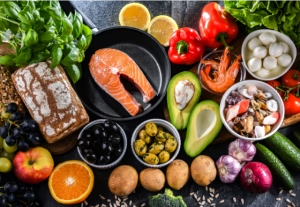
3. Eat DASH Diet Foods
DASH Diet stands for Dietary Approaches to Stop Hypertension. This diet is rich in fruits and vegetables and lowers blood pressure. The DASH Diet can help you have more energy and loose weight too!
- Why it matters: Can lower blood pressure as much as medicine in some people
- The goal: More vegetables, fruits, whole grains, lean proteins
- How to start: Add one extra vegetable to dinner and switch to whole grain bread
Figuring Out Where to Start
Ask Yourself:
- Which change feels most doable right now?
- What fits into your current routine?
- Where do you have the most control?
Remember: The best change is the one you’ll actually stick with. You can always add more later.
More Ways to Meet Your Goals
The big changes you read about – like cutting salt in half or exercising 150 minutes a week – can feel overwhelming. But small changes add up. Each quick win makes the next step easier and builds your confidence. As you add more and more small changes, you naturally reach those bigger goals.
For Eating Less Salt
- If you add salt to food: Try herbs and spices instead
- If you eat a lot of packaged foods: Choose “low sodium” versions
- If you eat out often: Ask for dressing/sauce on the side
- If you snack on chips/crackers: Replace one salty snack with fruit
For Exercise
- If you sit all day: Take 5-10 minute walking breaks
- If you have no time: Walk while talking on phone, take stairs
- If you hate exercise: Try dancing, gardening, active housework
- If weather stops you: Walk inside, do jumping jacks during TV commercials
For DASH Diet
- If you rarely eat vegetables: Add one extra vegetable to dinner
- If you skip breakfast: Try oatmeal with fruit
- If you drink sugary drinks: Replace one with water or unsweetened tea
Quick Answers
Salt is the biggest food culprit. Most Americans eat twice as much as they should (about 3,400 mg daily vs the recommended 2,300 mg).
Any fruit will help, because they have fiber. Bananas are a great choice, because they are packed with potassium. Just make sure to eat the whole fruit and not dried or processed options. Dried fruit has less fiber and more sugar.
Any movement helps, but moderate exercise like brisk walking, swimming, or cycling works best. Start with 10-20 minutes a day.
Start with 150 minutes per week (about 20 minutes a day). As you increase, more is better. Some research has shown people who get 60+ minutes a day may counteract the harms of sitting all day.
Related Articles
Beyond Diet & Exercise
Find out what else can help your blood pressure beyond the basics including the pros and cons of each approach.
Home Blood Pressure Monitoring
Learn when home monitoring helps, how to choose the right monitor, and how to make sure your readings are accurate.
Blood Pressure Medicine Types
Learn about the different types of blood pressure medicines, how they work, and what you can do for common side effects.
Don't see what you need?
Tell us what health topics confuse you. Your suggestions help us decide what to create next.
Resources We Used
Appel L. Salt intake and hypertension. UpToDate. December 19, 2023. https://www.uptodate.com/contents/salt-intake-and-hypertension?topicRef=3852&source=see_link#H2396155834.
Belanger MJ, Kovell LC, Turkson-Ocran RA, et al. Effects of the dietary approaches to stop hypertension diet on change in cardiac biomarkers over time: results from the DASH-sodium trial. J Am Heart Assoc. 2023;12(2):e026684. https://doi.org/10.1161/JAHA.122.026684.
CDC. About sodium and health. Salt. April 19, 2024. https://www.cdc.gov/salt/about/index.html.
Dunstan DW, Dogra S, Carter SE, Owen N. Sit less and move more for cardiovascular health: emerging insights and opportunities. Nat Rev Cardiol. 2021;18(9):637-648. https://doi.org/10.1038/s41569-021-00547-y.
Exercise in the treatment and prevention of hypertension – UpToDate. Accessed October 28, 2024. https://www.uptodate.com/contents/exercise-in-the-treatment-and-prevention-of-hypertension?topicRef=3852&source=see_link.
Filippou CD, Tsioufis CP, Thomopoulos CG, et al. Dietary approaches to stop hypertension (DASH) diet and blood pressure reduction in adults with and without hypertension: a systematic review and meta-analysis of randomized controlled trials. Adv Nutr. 2020;11(5):1150-1160. https://doi.org/10.1093/advances/nmaa041.
Grillo A, Salvi L, Coruzzi P, Salvi P, Parati G. Sodium intake and hypertension. Nutrients. 2019;11(9):1970. https://doi.org/10.3390/nu11091970.
Review Process
We take quality seriously. Every health guide goes through this review process:
Medical Review
At least one doctor in the content field reviews all health information
MD, DO, PhD/PsyD, OD, DMD, DDS depending on the content
Doctors check that all medical facts are correct
We update our content when new medical evidence comes out
Sources & Evidence
- All content is based on current medical guidelines and research
- We cite our sources so you can learn more
Reading Level Check
- We test all content to make sure it’s easy to read
- We avoid medical jargon or explain it clearly when needed
- We break down complex topics into simple steps
Accessible Design
- We design materials to work for people with different needs
- We use clear fonts and good color contrast
- We organize content with clear headings and simple layouts
- We follow web accessibility guidelines
We regularly review and update our materials based on:
- New medical research
- User feedback
- Changes in medical guidelines
You can find the last update date at the top of each page.
Found an error or have a suggestion?
Contact Us – We want to fix it as soon as possible!
Disclaimer
The information provided by HealthEd for Everyone is for educational and informational purposes only and is not intended as medical advice. While we strive to ensure the accuracy and timeliness of this information, it should not be used as a substitute for professional medical consultation, diagnosis, or treatment. Always seek the advice of your physician or other qualified health provider with any questions you may have regarding a medical condition.
HealthEd for Everyone does not endorse or recommend any specific tests, physicians, products, procedures, opinions, or other information that may be mentioned within this material. Reliance on any information provided by HealthEd for Everyone is solely at your own risk.
In no event shall HealthEd for Everyone be liable for any direct, indirect, consequential, special, exemplary, or other damages arising therefrom.
By accessing this information, you acknowledge and agree to these terms and conditions. If you think you may have a medical emergency, call your doctor, go to the nearest hospital, or call emergency services immediately.