Home » For Families & Kids » How to Help when Your Child Is Worried
How to Help when Your Child Is Worried
Author: Dr. Vrolijk | Updated: February 5, 2026 | Disclaimer | Review Process | References
Every kid gets scared sometimes. When they’re worried about medical care, it can make an already tough situation even harder.
One way to support your child is to learn more about their worry and make a plan. This works best when your child is calm and feels safe, not right before the appointment.
Give yourself time to explore the questions below. You may not figure it all out in one sitting but instead make a little progress each time.
While our examples focus on medical care, you can use this for any situation. You can also do a simpler it for younger children by focusing on their worry and what might help.
On This Page:

Help with Big Worries
Name Your Worry
- Help your child say what they’re worried about in one simple sentence
- Let them draw it if talking is hard
- Example: “I’m scared the shot will really hurt”
Ask Helpful Questions
Try these questions with any worry:
- What happened last time we went to the doctor?
- What can we do to help you feel safer?
- What should we bring with us to help you feel better?
Make a Plan
Based on what you find, make a plan for the appointment. For example:
If they remember good past experiences:
- Help them connect that to this visit: The doctor was gentle last time, so they’ll probably be gentle this time too
- Make a plan: And if you do get scared, what should we do?
If their worry is about something that will actually happen (like shots hurting):
- Acknowledge it’s real: You’re right, shots do hurt for a moment
- Make a plan: Let’s decide what you’ll do – squeeze my hand, count to 10, or watch a video
If their worry seems bigger than what will actually happen:
- Share your thought process: I think the doctor will be gentle because that’s what happened before. But the doctor can still be scary even if they’re gentle
- Make a plan: It’s okay to still feel scared – what would help you feel safer?
Why This Works
When a child or adult is scared, that fear can feel like reality. It can take over and make it hard to see anything else. When we avoid the things that scare us, the fear can grow even stronger. This exercise helps by identifying the feeling, looking at what they know, and making a plan. It’s based on well studied strategies used in cognitive behavioral therapy (CBT). Instead of trying to not feel scared, the goal is to better understand the feeling and find ways to move forward.
First, your child puts the worry into words. This turns a big, overwhelming feeling into something specific you can talk about.
Then, you and your child talk about what’s happened before. Most of the time our fears don’t match our experiences. Experiences can be used to better predict what’s likely to happen this time.
Finally, you make a plan. The plan gives your child a way to face the situation instead of avoiding it. It focuses on ways to feel more comfortable and safe while they face their fear.
More Support
Some kids need more support with medical visit worries, and that’s completely normal. A therapist can be helpful because they:
- Have special training in helping kids with medical anxiety
- Teach tools specifically for doctor visits and medical procedures
- Help families work together on these challenges
- Keep everything private (confidential)
- Focus on your child’s specific needs
Many kids find it helpful to have someone outside the family to talk to about medical worries.
Learn more about finding mental health support on our Mental Health: Getting Help page.
What to Read Next

Quick Calming Techniques
Simple activities to help children manage worry.
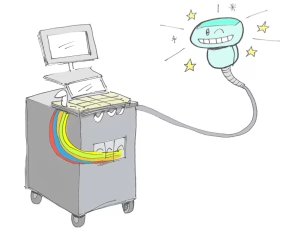
I Can Get an Ultrasound
Illustrated book that walks through what happens during an ultrasound.

Helping Your Child Prepare
Ways to explain what will happen and support your child's feelings.

Resources We Used
Clinical experience from multiple clinicians
Review Process
We take quality seriously. Every health guide goes through this review process:
Medical Review
At least one doctor in the content field reviews all health information
MD, DO, PhD/PsyD, OD, DMD, DDS depending on the content
Doctors check that all medical facts are correct
We update our content when new medical evidence comes out
Sources & Evidence
- All content is based on current medical guidelines and research
- We cite our sources so you can learn more
Reading Level Check
- We test all content to make sure it’s easy to read
- We avoid medical jargon or explain it clearly when needed
- We break down complex topics into simple steps
Accessible Design
- We design materials to work for people with different needs
- We use clear fonts and good color contrast
- We organize content with clear headings and simple layouts
- We follow web accessibility guidelines
We regularly review and update our materials based on:
- New medical research
- User feedback
- Changes in medical guidelines
You can find the last update date at the top of each page.
Found an error or have a suggestion?
Contact Us – We want to fix it as soon as possible!
Disclaimer
The information provided by HealthEd for Everyone is for educational and informational purposes only and is not intended as medical advice. While we strive to ensure the accuracy and timeliness of this information, it should not be used as a substitute for professional medical consultation, diagnosis, or treatment. Always seek the advice of your physician or other qualified health provider with any questions you may have regarding a medical condition.
HealthEd for Everyone does not endorse or recommend any specific tests, physicians, products, procedures, opinions, or other information that may be mentioned within this material. Reliance on any information provided by HealthEd for Everyone is solely at your own risk.
In no event shall HealthEd for Everyone be liable for any direct, indirect, consequential, special, exemplary, or other damages arising therefrom.
By accessing this information, you acknowledge and agree to these terms and conditions. If you think you may have a medical emergency, call your doctor, go to the nearest hospital, or call emergency services immediately.
Don't see what you need?
Tell us what health topics confuse you. Your suggestions help us decide what to create next.